
With KYGEVVI, improved survival time from treatment start is possible.1

~86% (95% CI: 61%, 96%) reduction in overall risk of death from treatment start vs the matched external untreated patient cohort.1
OVERALL SURVIVAL IN PATIENTS WITH TK2d (AGE OF SYMPTOM ONSET ≤12 YEARS) TREATED WITH KYGEVVI VERSUS MATCHED UNTREATED PATIENTS (EXTERNAL CONTROL)1*
Treated Patients | Matched Untreated | |
|---|---|---|
Number of deaths, n(%)† | 3 (3.8%) | 28 (35.9%) |
Restricted mean survival time, years (95% CI)†‡ | ||
At 4 years post treatment start | 3.8 (3.7, 4) | 2.6 (2.2, 3) |
At 6 years post treatment start | 5.8 (5.5, 6) | 3.7 (3, 4.3) |
At 10 years post treatment start | 9.6 (9.2, 10) | 5.7 (4.5, 6.9) |
Hazard Ratio§ | ||
Risk of death from treatment start (95% CI) | 0.14 (0.04, 0.39) | |
96%
(n=75/78)
of treated patients were alive at follow-up. 3/78 deaths in treated patients.1
64%
(n=50/78)
of untreated patients were alive at the end of the study. 28/78 deaths in matched untreated patients.1
CI=confidence interval.
*Treated patients were originally from Trial 1 (n=9), Study 1 (n=27), Study 2 (n=11), and the expanded access program (n=31). Untreated patients were from published literature (n=57) and Study 2 (n=21).1
†An additional censoring step for untreated subjects was performed for each matched pair where the untreated subject died and had a longer follow-up time than the matched treated subject who was censored. The follow-up time of the untreated subject was then censored at the follow-up time of the treated subject.1
‡Based on the area under the survival curves up to 4, 6, and 10 years post treatment start.1
§Estimates based on Cox proportional hazard model with Firth correction that includes matched pair as a strata, age of symptom onset as a continuous covariate, and treatment (treated or untreated) as a time independent variable.1
Note: Treated patients were matched 1:1 to untreated patients by category of age of TK2d symptom onset (≤2 years or >2 to ≤12 years). Within each category of age of symptom onset, the matching was performed as follows: treated patients were sorted in descending order, according to their age of treatment initiation; the first treated patient in the sorted list was matched with the sorted untreated patient having the highest last known age; this matched untreated patient was then no longer available for matching with any remaining treated patients; the procedure continues in order through the sorted list of treated patients. Time of treatment start in the untreated patient was set to that of the matched treated patient.1
KAPLAN-MEIER SURVIVAL CURVES FOR TIME TO DEATH FROM TREATMENT START IN PATIENTS WITH TK2d TREATED WITH KYGEVVI AND MATCHED UNTREATED PATIENTS (EXTERNAL CONTROL)1‖¶
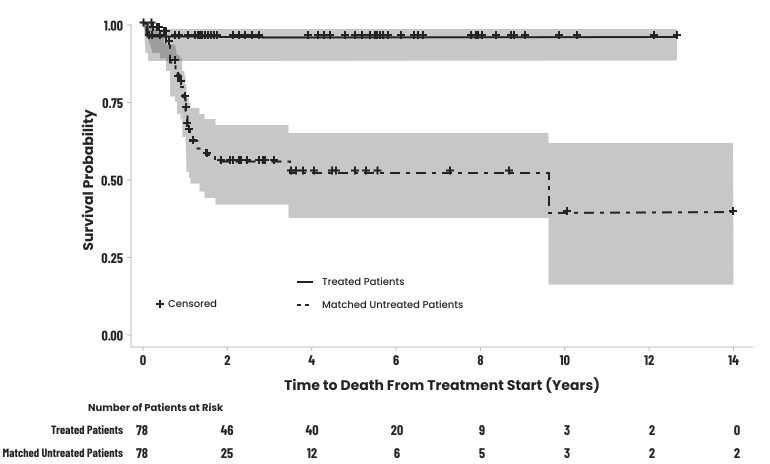
||Treated patients were from Trial 1, Study 1, Study 2, and the expanded access program. Untreated patients were from published literature and Study 2.1
¶Kaplan-Meier curves with 95% confidence intervals using log-log transformation and with treatment group as strata variable; age of TK2d symptom onset ≤12 years. An additional censoring step for untreated subjects in the footnote above with the † was performed.1
VIEW THE KYGEVVI SAFETY PROFILE.
Learn about the most common adverse reactions reported in studies with KYGEVVI treatment.
Reference
- KYGEVVI (doxecitine and doxribtimine) U.S. Prescribing Information. Smyrna, GA: UCB, Inc.
