UCB offers helpful resources for your patients with early-onset TK2d.

ONWARD logo.

ONWARD® is a single point of entry for patients to experience personalized support while taking KYGEVVI

Prescribed patients and their caregivers will receive:

Personalized support from a dedicated Care Coordinator* throughout the treatment journey

Coordination between PANTHERx Rare, the exclusive specialty pharmacy for KYGEVVI, and ONWARD’s case management team throughout the insurance approval process

Help with reviewing insurance coverage and potential financial assistance options

Preparation and administration support from PANTHERx Rare

Tools and resources to get started and ongoing treatment support

Start patients prescribed KYGEVVI with ONWARD for comprehensive support

Complete the ONWARD Start Form with your patient during their next visit, or initiate your patient's enrollment via an e-Start Form.

Fax the completed form to: 1‑833‑FAX‑UCB‑1 1-833-FAX-UCB-1 (1‑833‑329‑8221).

*ONWARD Care Coordinators do not provide medical advice and will refer patients to their healthcare professional for any questions related to their treatment plan.

The Music Box: An early-onset TK2d story

Every person with early-onset TK2d experiences their own unique journey to diagnosis and treatment. Watch the journey of a father and his son as they experience the onset of symptoms, search for a diagnosis, and ultimately receive treatment.

Individual results may vary.

Download these resources to help with KYGEVVI access.

Download these resources for information about KYGEVVI.

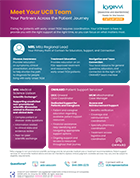
Download these helpful resources for patients who are prescribed KYGEVVI.

Connect with the mitochondrial disease community

Additional resources from advocacy groups are available to you and your patients.

mitoACTION logo.

MitoAction aims to improve the quality of life of people living with mitochondrial diseases through support, education, and outreach.

Mitochondrial Care Network logo.

Mitochondrial Care Network (MCN) creates and implements best practices in mitochondrial medicine.

Muscular Dystrophy Association logo.

Muscular Dystrophy Association (MDA) provides support and resources for people living with neuromuscular diseases like TK2d.

UNITED MITOCHONDRIAL DISEASE FOUNDATION logo.

The United Mitochondrial Disease Foundation (UMDF) provides resources, patient support, a database of experts, and more.

LET'S CONNECT.

Get more information about KYGEVVI.

Contact a UCB representative  

INDICATION

KYGEVVI is indicated for the treatment of thymidine kinase 2 deficiency (TK2d) in adults and pediatric patients with an age of symptom onset on or before 12 years.

IMPORTANT SAFETY INFORMATION

Increase in Liver Transaminases

Elevated liver transaminase [alanine aminotransferase (ALT) and/or aspartate aminotransferase (AST)] levels were reported in patients treated with KYGEVVI. Obtain baseline liver transaminase (ALT, AST) and total bilirubin levels in patients prior to treatment initiation with KYGEVVI.

INDICATION

KYGEVVI is indicated for the treatment of thymidine kinase 2 deficiency (TK2d) in adults and pediatric patients with an age of symptom onset on or before 12 years.

IMPORTANT SAFETY INFORMATION

Increase in Liver Transaminases

Elevated liver transaminase [alanine aminotransferase (ALT) and/or aspartate aminotransferase (AST)] levels were reported in patients treated with KYGEVVI. Obtain baseline liver transaminase (ALT, AST) and total bilirubin levels in patients prior to treatment initiation with KYGEVVI. If signs or symptoms consistent with liver injury are observed, interrupt treatment with KYGEVVI until liver transaminase (ALT, AST) and total bilirubin levels have either returned to baseline or stabilized at a new baseline value. Consider permanently discontinuing KYGEVVI if signs or symptoms consistent with liver injury persist or worsen. Monitor liver transaminases and total bilirubin levels yearly and as clinically indicated.

Gastrointestinal Adverse Reactions 

Diarrhea and vomiting leading to hospitalization, dose reduction, and permanent discontinuation were reported in patients treated with KYGEVVI. Based on the severity of the diarrhea and/or vomiting, reduce the dosage of KYGEVVI or interrupt treatment until diarrhea and/or vomiting improves or returns to baseline. Consider restarting KYGEVVI at the last tolerated dose, and increase the dose as tolerated. For persistent or recurring diarrhea and/or vomiting, consider discontinuing KYGEVVI permanently and provide supportive care with electrolyte repletion as clinically indicated.

Adverse Reactions

The most common adverse reactions (incidence ≥5%) are diarrhea, abdominal pain (including abdominal pain upper), vomiting, alanine aminotransferase increased (ALT), and aspartate aminotransferase increased (AST).

Please see the full Prescribing Information.